
3 Min. Gold News
Agustín Carstens speaks about inflation, monetary policy and digital currencies.
Interview (only available in German) with Mr Agustín Carstens, General Manager of the BIS, in Germany’s Frankfurter Allgemeine Zeitung, conducted by Mr Gerald Braunberger on 18 March 2024 and published on 26 March 2024. https://www.bis.org/speeches/sp240405.htm
#inflation #CBDCs
Topics:
Crazy Inflation
Russia Russia Russia
Goodbye Low Interest Rates
CBDCs
Synopsis of the head of the BIS (Bank for International Settlements) – the central bank of central banks.
Agustin Carstens is the head of the Bank for International Settlements (BIS) which runs the world financial system.
The central banks decide interest rates and provide banking services for nations (and others).
Commercial banks create debt-based fiat currency, meaning when you take out a loan they create the ‘money’ out of thin air based on your promise to pay it back with interest.
That’s our two-tier, two layer world financial system.
The public doesn’t usually see the top layer. It’s kept unclear on purpose say Carstens.
Carstens speaks to a German media outlet and it’s not translated into English on the BIS website. That’s unusual.
Carstens says the recent worldwide spike in inflation was a surprise to the BIS.
A surprise. To them. The ones running the current world system.
The BIS had locked down the world’s economy for the pandemic and they casually thought they could start it back up on a dime. Carstens says that was their error.
Nations printed a boat load of money and central banks lowered interest rates during the lockdowns. All good they said. No problem starting it up again.
When the pandemic ended people wanted to buy things, but the supply of goods didn’t rise to meet the sudden demand. People didn’t hop back to work to build things. People were damaged. Supply chains didn’t snap back into run mode.
There wasn’t an emerging nation willing to start up manufacturing for an even lower price than the last emerging nation the BIS called on.
Nations began to think of their own best interests and their national sovereignty, and there was a reverse in the momentum of globalisation.
A rise in demand used to mean a following rise in supply. When people wanted stuff then other people built the desired stuff. Everyone was happy and the middle made their cut. Bankers collected their fees for the payments.
That didn’t happen when the lockdowns ended.
Instead, prices rose because there wasn’t enough stuff to meet the demand.
There needed to be a reason, and so central bank speeches began pointing to Russia entering Ukraine and they immediately stopped admitting they made an error.
The speeches all pivoted to ‘Russian aggression” causing the supply chain issues.
SUPPLY
Central banks can’t control supply.
They can’t make people build things.
They can’t make people spend their money instead of saving it. All they do it control demand by raising interest rates to make it harder to borrow to buy anything new, and make the rates so low that those in the know can borrow, flip and make a profit without effort.
Inflation is falling now, says Carstens in this interview, because many supply issues have disappeared and, of course, the “central banks’ important contribution” helped.
He fails to say what that important contribution was.
The central banks raised interest rates fast and high to manipulate the demand lower, so less people could afford to borrow, and less people could buy stuff. Therefore there was then enough supply for the lower demand.
DEMAND
Carstens says central banks only control demand so economists only think about demand.
He says that used to work but doesn’t work anymore.
Since they can’t control supply chains, and supply isn’t following demand anymore, they have to understand the threats to supply. He says.
The central banks now need to somehow manipulate supply as well as demand, since controlling demand is no longer working.
Their goal was one financial system, led by them, called ‘globalisation’.
But, some nations are aware now, how it can hurt their citizens to help the central bankers rule the globe. They’ve stopped or want to stop sacrificing their national sovereignty and standard of living for outside control that can hurt them.
Carsten says there are threats to globalisation. He means threats to globalisation are those nations and politicians who don’t want to sacrifice their own nation’s interests for an international group who want to make the decision to lower your standard of living to help themselves monitor and control your citizens. Whew.
Like a global communism.
Carsten says the BIS needs to understand global supply chains better.
He admits openly they don’t understand global supply.
On an aside, a CBDC (central bank digital currency) can be programmed, which means they could then control supply by making the holders spend it as the BIS wants.
The BIS could then stop people from moving their own money quickly to another nation, or to buy want then want when they want, or to save if they want.
The BIS goal is stability. But their definition of stability is to keep the current system stable – the system where they rule and take a cut for each movement of money. Where they harvest the citizens.
GOOD BYE LOW INTEREST RATES
Carstens says low interest rates are probably not coming back any time soon.
Because:
1. Lots of nations have added massive debt in the last few years.
2. Aging populations mean some nations have to increase spending on healthcare and pensions.
3. National security budgets have to increase because of war tension.
4. Climate change and damage from disasters will cost.
5. He alludes to possible higher “production” with high rates, which reminds me of a UN rep saying that people who are financially distressed are more productive, and the BIS system needs more supply/production.
Climate is changing, but debate is on whether oil is an issue, or carbon is an issue, if the change is part of the planet’s natural cycle, or if making citizens pay an additional tax to compensate for carbon production is a weird/disingenuous way of getting more money from citizens to pay the obscene debt of those in power.
Those in power who hurt citizens with bad decisions and too much debt, and have models that don’t work.
Lots of debate going on. Lots of angry people out there.
One speech from the BIS last year said that you should get behind their new digital CBDC system or else a competing one (like BRICS meaning China) won’t be to your benefit, or will be even more against you and be more controlling.
Carstens says central banks are independent in order to prevent permanently higher interest rates.
What he means is that politicians want to take on more debt to win votes, and that means higher interest rates to pay back the bigger debt, which is already so big it can never be paid back.
Are central banks independent of governments?
Two years ago Christine Lagarde, head of the European Central Bank, made a speech telling governments they had to increase taxes to save the fiat system. She even suggested they call it a carbon tax. And they did. Lagarde even said it would be hard on the middle and lower classes. No doubt.
On an aside, it was the Singapore central bank who gave money to the lower classes, who the central said were suffering from “no fault of their own”.
Lagarde said in an even earlier speech that the commercial banks wouldn’t play ball to make a new system that cut their own fees, so Lagarde told the governments they needed to increase taxes to get more money to appease the commercial bankers.
That way the BIS could rescue the system, and let the new big tech private companies take a cut in the evolving digital payments world while the commercial banks still made huge profits.
She even told the commercial banks to lower their income projections to medium term instead of short term. I’ll look that speech up if anyone wants a link.
If inflation stays high for too long then people expect it and wages rise to match the rising prices.
Then prices of everything go up and the costs of the parts rise to pay the higher wages.
If expectation is short term people just spend less for a while.
If they believe it’s long term they make life changes – big changes that are unpredictable for the central bankers.
Central bank debt has also risen says Carstens. It’s started to fall a bit, but not very fast. It might not return to pre-crisis levels.
So interest rates will probably stay high for a long time.
MODELS
Carstens says models aren’t perfect. He says they’re “just a source of information”.
“At the end of the day, monetary policymakers use their common sense and intuition.”
No kidding. Carstens said that. Common sense and intuition. They don’t use data because their data and models are flawed.
Inflation comes from the interaction of all the forces in an economy he says. But, these forces change, he also says.
Then Carstens says they need to be flexible in order to analyse the situation at hand.
They need to ensure price stability in any environment.
They need “extensive digitalisation in business life that brings down costs a lot and enables transactions that aren’t possible today.”
He’s talking about business CBDCs – institutional level which is tier one.
If they don’t get there fast and roll out their CBDC then businesses will just use digital commercial bank payment systems that are developing quickly.
RETAIL CBDCs
Carstens says they aren’t talking about CBDCs for private households. (wink)
At the same time he says, “It would be difficult for central banks to accept no longer having a direct stake in people’s payment habits.”
The BIS can’t see a reason to give up the fees and input they have over private citizen payments.
Physical cash is central bank money. Everything else, the digital money and loans, is commercial bank money.
But lots of people aren’t using cash anymore.
He says they want to offer an alternative to cash for young people to use on their phones to pay.
Commercial banks see that as competition for business. Big tech private companies are already developing digital payment systems, which is competing with commercial banks, but they’re keeping their data to themselves.
How can the BIS learn about supply if all the data is behind private company walled gardens?
How can the central bank get the data they want, to make the models they want, so they won’t have to use “common sense and intuition” to manage the whole world’s financial system?
Carstens says commercial banks can compete with CBDCs if they want to offer digital financial products. Uh huh.
He says commercial banks and central banks should work together.
So he says they “can compete” and they “should work together” at the same time.
This is one of the reasons why many are turning to physical gold as a hedge against an uncertain outcome.
Gold rises when trust in government falls.
Gold rises when trust in the system fails.
Gold is a tier one asset according to the BIS.
Central banks are buying it. Citizens are now buying it.
We’re here.
~ Elaine
……………………………………….
Thank you to Jim Rickards for including me in his bestselling book The New Case for Gold.

……………………………………….
Nothing on this site is intended as individual investment advice. We’re all watching which way the wind is blowing.
……………………………………….
Thank you to Mike Maloney for including me in Episode 1 of his bestselling series Hidden Secrets of Money.
Coins and Crowns
words and music Elaine Diane Taylor
SOCAN/ASCAP
from the album Coins and Crowns
Coins and Crowns is featured in Episode 1 of Mike Maloney’s bestselling series Hidden Secrets of Money.
……………………………………….
Not Much of a Holiday (Bank Holidays and Media Persuasion)
words and music Elaine Diane Taylor
Single available on iTunes
……………………………………….
A Terrible Breeze (War and Social Media)
The news comes down
A little bluebird sings
Words of war
Fire and furious things
Of testing might
‘Til no patience knows
If keeping still
Still keeps you safe at home
It’s a terrible breeze
They speak of today
Of threats that used to live a world away
We all know wind
Can blow both ways
And a terrible breeze can blow it all away
A worldwide net
Sees our village grow
Until we all forget
What each one used to know
How a blind bird’s wings
Can reach the shore
And turn the wheel of peace and war
Village fools sinking down, down, down
Debt and gold wound in numbered shrouds
Deal of a life it’s bread and clowns
Can we afford another go around?
The news comes down.
It’s a terrible breeze. The news comes down.
words and music Elaine Diane Taylor
Single available on iTunes
……………………………………….
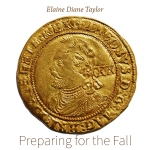
Preparing for the Fall is a live boutique album available for digital download — featuring Wag the Dog, Black Swan Dive, American Pie and Gods of the Copybook Headings. Also available on iTunes, Google Music, Amazon Music and major digital distributors.
……………………………………….
The Gods of the Copybook Headings
words by Rudyard Kipling and music by Elaine Diane Taylor
from the album Preparing for the Fall.
The copybooks of the early 1900s gave us all the wisdom we need. The sayings that were copied are the truths, the gods of our world. All the empires who followed the gods of the marketplace have fallen, and there’s terror and slaughter when the gods of the copybook headings return. The lyrics are by Rudyard Kipling. One of my gurus.
Another Week on Wall Street
words and music Elaine Diane Taylor
from the album Coins and Crowns.
“A little grease (Greece) is floating out to sea, and little pigs (Portugal, Italy, Greece and Spain) are bobbing up and down, they’ll send a storm and we’ll see, when the tide goes out who’s naked on the beach“. The world is changing as we know it.
……………………………………….
Nothing on this site is intended as individual investment advice. We’re all watching which way the wind is blowing.
……………………………………….


Communication Theory….
As the alphabet took the magic of words and divided them into tiny repeatable units, strung along and carried in written form, then reformed into words and meaning in the quiet of one’s own mind, so currency separates commodities and items of value into concise repeatable units.
The currency is packaged, shipped, identical, and is value as exchange for meaning of value to the receiver.
The oral societies are not led by the alphabet; they are led by the voice and ear. So each item is different, unique, and exchange is bartered over for each unit. These countries will not easily move to digital wallets and identical purchases. The unbanked are sometimes unbanked by choice.
Those in power talk about taking care of the ‘unbanked’. But the care is misplaced. A new bank account will earn the banker fees, and the expansion of the currency supply is not a desire of the central banking system, it is it’s lifeblood.
To keep their central bank system going they must have ever expanding borrowing and debt.
Their system has failed because it has to fail.
Sooner or later you run out of people to lend to, so they’ve created a ‘green’ issue to make new reasons to create more debt.
The business cycle cannot be stopped; it rises and falls as every closed system does. They know this, and so those in power are rushing to cement control with new technology before the first out of the gate with new products beat them to market share. The rush is to try to regulate to keep the status quo.
But it’s impossible.
My biggest concerns at the moment come from Understanding Media, written by Marshall McLuhan. He writes of Nobel prize winning author Alias Canneti’s book, Crowds and Power, talking about the psychic effects of the Germany hyperinflation after the First World War.
The depreciation of the citizen went along with that of the German Mark.
There was a loss of face and of worth, in which the personal and the monetary units became confused.
When everything is mechanical, it includes thoughts, money and humans. I hope that confusion doesn’t return.
Elaine~

It’s a terrible breeze
They speak of today
Of threats that used to live a world away
We all know wind
Can blow both ways
And a terrible breeze can blow it all away
A worldwide net
Sees our village grow
Until we all forget
What each one used to know
How a blind bird’s wings
Can reach the shore
And turn the wheel of peace and war
Village fools sinking down, down, down
Debt and gold wound in numbered shrouds
Deal of a life it’s bread and clowns
Can we afford another go around?
The news comes down.
It’s a terrible breeze. The news comes down.
words and music Elaine Diane Taylor
Single available on iTunes
 Elaine Diane Taylor